

Navigate Anxiety One Step at a Time
"Anxiety, most simply described, is our response to threat, whether real or perceived. The response is physiological; it is chemical. It occurs because of brain activity that is outside our awareness; we never even have to think about it. Thankfully, we can respond to threat in the link of an eye. ... We experience anxiety in two forms: acute and chronic.
- Acute anxiety is our reaction to a threat that is real and time limited.
- Chronic anxiety is when we imagine or distort a threat, that despite our feeling is not real. Consequently, it is not time limited either; it does not simply go away."
[Adapted from 'The Leader's Journey by Herrington, Taylor & Creexh, P.44]
Anxiety is a common experience that can feel overwhelming, but for many people some simple daily strategies can help you regain calm and control.
Try these simple practical steps:
- Box Breathing: Inhale for 4 seconds, hold for 4, and exhale for 4. (See video below.)
- Ground Yourself: Focus on five things you can see, hear, or touch right now. (See video below.)
- Move Your Body: A brief walk releases physical tension.
- Reach Out: Talk with a trusted friend or make an appointment with a healthcare professional.
- Connect: Join a community of people who care enough to offer you unconditional acceptance.
Small steps can lead to meaningful, long-term relief.
Following are some helpful books which are available on Amazon or perhaps your local bookstore. (Our church library has them available to borrow.)
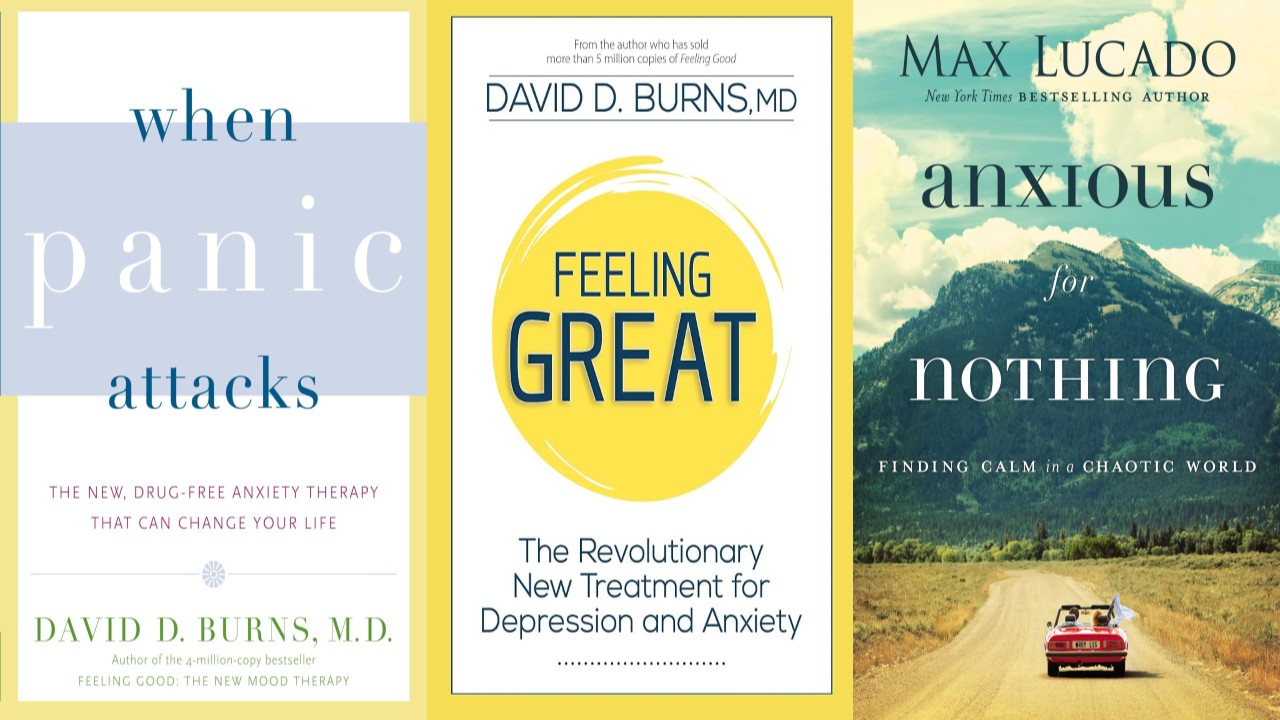
Following is a useful article from Charles Duhigg's, author of 'The Power of Habit'.
How To Control Your Mind
All of us get obsessed sometimes. We overthink, we ruminate, we're desperate to stop thinking about [fill-in-the-blank]. Luckily, science has suggestions on how to find peace.
There are five basic tools for controlling your thoughts:
1. When you can’t stop thinking about something, write it down.
Intrusive thoughts usually don't have a structure, so they bounce around our heads. One solution is to write out your thoughts and feelings, without worrying being eloquent — just keep your pen moving. Writing forces the memory into a story with a beginning, middle and end, and once you have a story, the mind sets it aside more easily. (Here's a video on this with Ethan Kross about his book 'Chatter'. https://www.youtube.com/watch?v=M0oZ4PE9VzY)
2. Use distanced self-talk.
Talk to yourself in the second or third person. For instance, it's better for me to say "Charles is struggling with this angry memory, but if he reflects on everything he's grateful for ..." than to say "I am struggling, but if I reflect ...".
How do we make this shift? Ask yourself what advice you'd give a friend, and then follow it yourself. What matters is using the same language you’d use if you were talking to someone else.
Also, try to name specifically what you're feeling. (As one psychologist puts it: "name it to tame it".) Getting specific on what we're feeling helps our brain put it aside ("oh, this isn't anger! It's anxiety! I know how to handle that!") If you're having trouble finding the name for your emotion, check out the How We Feel App at https://howwefeel.org/
3. Be careful with venting.
Venting with a friend has it's place ("Can you believe she said that?! Let me tell you what happened next!") and can feel good — but it often backfires and becomes what's know as “co-rumination.” It leaves you all riled up with those thoughts even more active in your head.
So, instead of picking a friend who will satisfy your emotional needs ("Oh my gosh! You must be so pissed!") find someone who will push you toward another perspective ("That sounds hard, but can you just ride it out? It's gonna end eventually, right?"). Make your goal reframing, out loud, what happened.
And, in case you were wondering, punching something only makes your anger worse.
4. Swap "what if!" for "so what?"
Instead of asking yourself "What if my book proposal doesn't sell?!" try asking yourself "So what if my book proposal doesn't sell? I'll probably have more time with my family, which would be great!"
And try to look at whatever is stressing you from the distant future. ("What are the chances I'll care about this five years from now?") Or think about what was stressing you five years ago, and ask if there's an insight there. ("Why did I care about getting invited to that party? It didn't matter. And so maybe today's invitation doesn't matter either?") In one study, simply whispering this too shall pass reduced the emotional intensity of memories and helped people recall that what they're feeling is temporary.
5. Give yourself a break (and some forgiveness).
Your thoughts are like a bus: passengers get on and off, and some are well-behaved, and some are rude. You can’t control who gets on and off, but you can control how much time you spend talking to the rude people.
It's okay if bad thoughts are in your head. Forgive yourself for having them, and just quietly wait until they exit. (In one study, people who habitually noticed negative feelings without judging themselves for them had lower rates of depression and anxiety.)
Some techniques for doing this:
Two sniffs in, one long sigh out. This is known as 'cyclic sighing' and it beats mindfulness and meditation in daily mood gains. 'Box breathing' (inhale for 4 seconds, hold it for 4 seconds, exhale for 4 seconds, wait 4 seconds before taking your next breath) is also great.
Schedule your anxiety. When worried adults are trained to postpone their anxieties until a 30-minute 'worry period' that always happens at the same time and in the same place, it reduced their anxieties throughout the day. Daily repetition is what matters — this can become a habit that helps you automatically set worries aside.
And, lastly, write tomorrow's to-do list at bedtime. In one study, right before getting into pajamas, people either wrote a to-do list for the coming day, or wrote a list of things they had accomplished that day. The to-do group fell asleep three times as fast, and the more specific the list, the better they slept.
But how do I help my kids, or my friends, or my spouse?
For young kids, playing pretend can help. In one experiment of young children (such as a child named, say, Emma), kids were assigned a hard and anxious task and were told to ask themselves either "Am I working hard?", "Is Emma working hard?" or "What would Batman do?". The Batman kids worked longer and harder than everyone else. (The same technique also works with teenagers, though "what would your friend do?" or "what would Taylor Swift do?" might be more effective.)
Among couples, pretending there is someone else in the room is useful: When researchers followed 120 married couples for two years, they found that small anxieties, annoyances and fights diminished significantly when couples spent 7 minutes writing about the tension from the perspective of a neutral third-party who wants what's best for everyone.
If you're trying to help a friend who is obsessing, tell them what they are feeling is legitimate, and then invite them to see if from a new perspective ("It sucks you didn't get that promotion, but is there a way to see this as something that gives you more freedom at your job?")
And, last of all, remember: Being hangry is real! People consistently see things as more negative and irksome when they are hungry. So, if you've typed out an annoyed email, get some lunch and re-read it before you hit send.
Accessed from email newsletter which you can sign-up for at https://www.scienceofbetter.net/newsletter-signup